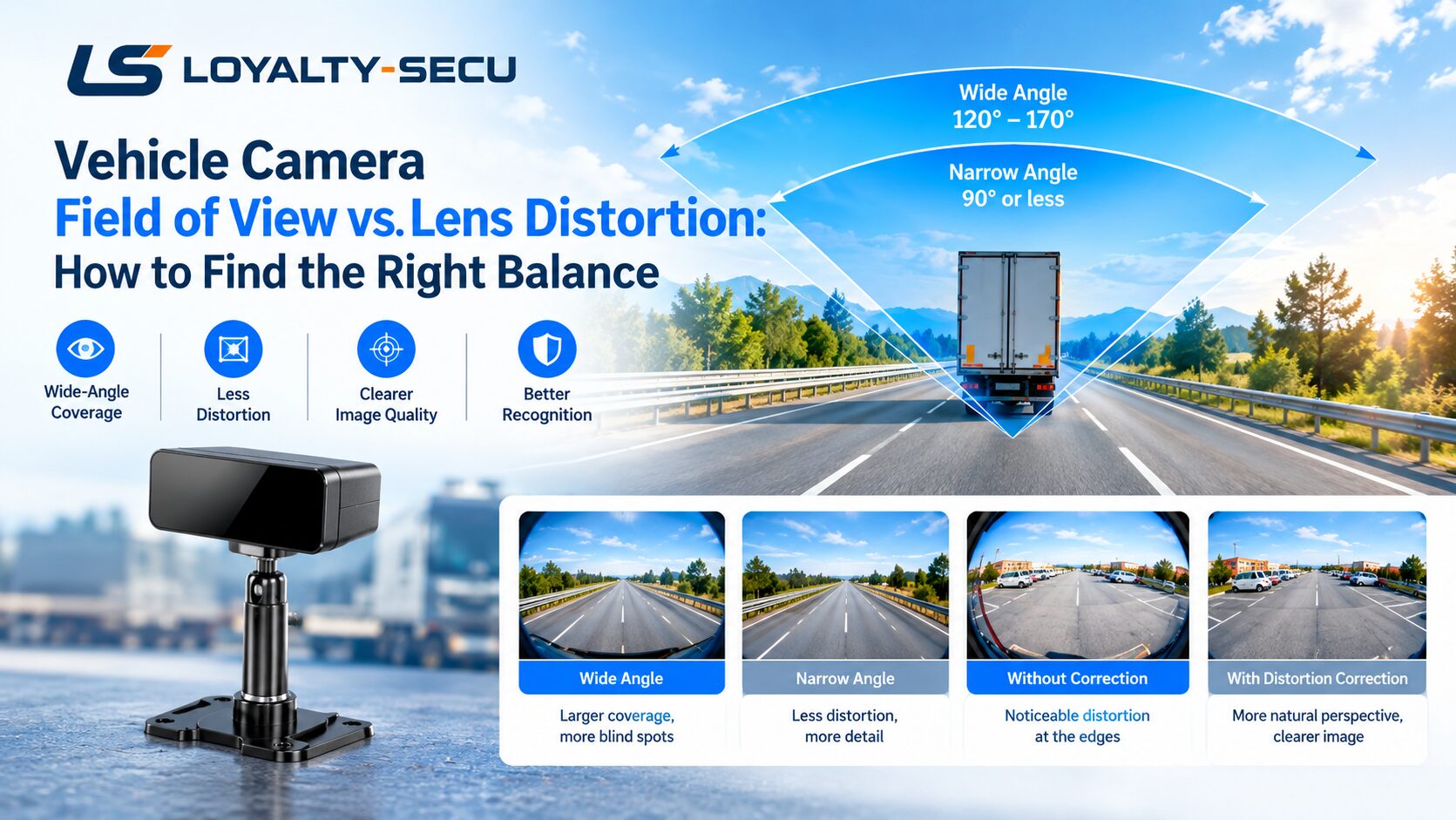
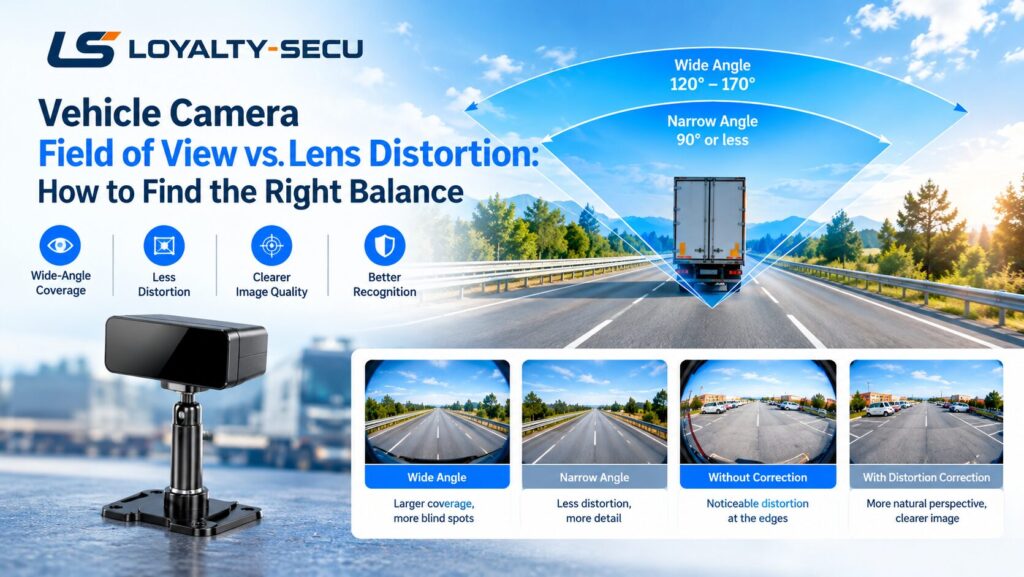
Vehicle cameras play an essential role in vehicle surveillance, driver safety, and fleet management. The camera’s field of view (FOV) directly affects the monitoring coverage, while lens distortion can influence image quality and object recognition.
Although a wider-angle lens can capture a larger area and reduce blind spots, it may also introduce image distortion, particularly around the edges of the frame. This can make objects appear stretched or curved and affect the visual interpretation of distances and positions.
For vehicle camera selection and installation, the key is to find the right balance between wide-angle coverage, image clarity, and accurate target recognition.
1. How Are Field of View and Lens Distortion Related?
The field of view refers to the area a camera can capture. It is commonly measured as horizontal, vertical, or diagonal FOV. When comparing vehicle cameras, it is important to confirm which measurement is specified, as these values are not directly interchangeable.
Narrower-angle lenses generally capture a smaller area but can provide a more focused view of important objects. Depending on the optical design and installation conditions, they may be suitable for forward-facing road monitoring, license plate capture, and applications that require detailed image information.
Wide-angle lenses capture a broader area and can help reduce blind spots around a vehicle. They are commonly used for cabin monitoring, reversing cameras, side-view monitoring, and vehicle interior surveillance.
However, ultra-wide-angle lenses may produce noticeable barrel distortion, causing straight lines to appear curved and objects near the edges of the image to look stretched. This can affect how viewers interpret an object’s shape and position.
It is important to note that a wider field of view does not automatically mean more severe distortion. The actual result depends on the lens design, sensor characteristics, image processing, and distortion correction technology.
2. How to Choose the Right Field of View for Different Vehicle Applications
The best lens specification depends on the camera’s installation position, monitoring objectives, and operating environment. Rather than simply choosing the widest available lens, it is better to evaluate the actual coverage and image quality required.
Forward-Facing Road Monitoring
Forward-facing vehicle cameras need to balance road coverage with the ability to capture important details at a distance.
For driving video recording, road monitoring, and incident evidence collection, the lens should provide sufficient coverage without making distant vehicles, road signs, or other important objects too small in the image.
The appropriate field of view depends on factors such as vehicle speed, camera mounting height, target distance, and the required level of detail.
Driver Cabin and Vehicle Interior Monitoring
Cabin monitoring often requires a camera to cover the driver, passengers, and other important areas within a limited space. A wide-angle lens can help capture a larger portion of the cabin and reduce blind spots.
However, if the system also performs driver monitoring or behavior analysis, image clarity becomes especially important. The driver’s face and other relevant areas must remain sufficiently visible for the intended detection tasks.
Choosing an excessively wide lens simply to capture the entire cabin may reduce the image detail available for analyzing important features.
Side-View and Reversing Cameras
Side-view and reversing cameras often need to cover a relatively wide area at a short distance. Wide-angle lenses can help drivers observe nearby obstacles and surrounding objects.
However, lens distortion and perspective effects may influence the apparent shape, size, and position of objects. For applications involving distance estimation or safety warnings, the system should be evaluated under actual installation conditions and calibrated according to its design requirements.
Visual appearance alone should not be used as a reliable measurement of actual distance.
3. How Can Lens Distortion Correction Improve Image Quality?
Both optical design and image processing can help improve the visual quality of wide-angle vehicle cameras.
Optical Lens Design
Choosing a lens with good distortion control can reduce geometric distortion at the source. For applications involving license plate recognition, object detection, or incident recording, edge sharpness and overall image detail should also be considered.
A suitable lens should provide the necessary field of view while maintaining adequate image quality across the areas that matter most.
Digital Distortion Correction
Some vehicle cameras and video processing systems support digital distortion correction. This technology uses image processing algorithms to compensate for geometric distortion and produce a more natural-looking image.
However, digital correction has limitations. Correcting distorted images may require remapping and cropping, which can reduce the effective field of view or affect image detail near the edges.
Therefore, software correction should not be treated as a complete solution for an unsuitable lens. Selecting the right lens remains an important first step.
Proper Camera Installation and Adjustment
Camera positioning is another key factor in achieving a useful field of view.
During installation, the camera should be adjusted to capture the intended monitoring area while keeping critical targets within regions of the image that provide sufficient clarity.
Installers should also check whether vehicle structures, mounting brackets, or other components obstruct the camera’s view.
For AI-based applications, performance should be tested in the actual installation environment rather than judged solely from static images. Factors such as lighting, vibration, motion blur, and target position can all influence recognition results.
4. How to Balance Wide-Angle Coverage, Image Quality, and AI Recognition
Different vehicle monitoring applications have different imaging requirements. Lens selection should therefore be based on the specific task the camera needs to perform.
- Driving video recording and incident evidence: Prioritize sufficient image detail, appropriate exposure, and clear visibility of important areas while maintaining adequate road coverage.
- License plate recognition: Consider the pixel size of the license plate in the image, capture distance, vehicle speed, shutter settings, and camera angle. An excessively wide field of view may make distant license plates too small for reliable recognition.
- Driver monitoring: Ensure that the driver’s face and other relevant areas remain clearly visible. Image quality should be evaluated under different lighting conditions and during actual vehicle operation.
- Vehicle surroundings and panoramic monitoring: Prioritize broad coverage and assess whether distortion correction or multiple cameras are needed to achieve the desired monitoring results.
Driver Monitoring: Balancing Field of View and AI Recognition
For driver monitoring applications, a wide field of view can help capture the driver’s face and upper body. However, an excessively wide-angle lens may cause facial distortion or reduce image details, potentially affecting AI-based fatigue detection and driver behavior analysis.
When selecting a driver monitoring camera, it is important to consider not only the field of view but also facial image clarity, camera installation position, lighting conditions, and AI recognition performance.
For example, LOYALTY-SECU’s DMS Driver Monitoring AI Camera is designed for driver monitoring applications in trucks and other heavy vehicles, supporting fatigue detection and fleet safety management.
Choosing the right camera configuration and installation angle helps ensure that key facial features remain clearly visible, supporting effective driver monitoring in practical operating environments.
It is also important to evaluate the complete system, including the camera, AI algorithms, installation position, and operating conditions, rather than relying on lens specifications alone.
5. Key Factors to Consider When Selecting a Vehicle Camera
Before choosing a vehicle camera, consider the following factors:
1.Field of view: Confirm the horizontal, vertical, and diagonal viewing angles and determine whether the coverage meets the application requirements.
2.Image resolution and detail: Ensure that important targets can be captured with sufficient detail at the required monitoring distance.
3.Lens distortion and edge sharpness: Check for noticeable geometric distortion and loss of clarity near the edges of the image.
4.Distortion correction: Determine whether the camera or associated system supports digital correction and whether correction affects the effective viewing area.
5.Installation and operating environment: Consider vibration, lighting changes, available mounting space, and target movement.
6.AI recognition requirements: For license plate recognition, driver monitoring, or other AI applications, validate the complete system through practical testing under representative operating conditions.
Evaluating these factors together can help avoid choosing a camera that offers a wide field of view but fails to deliver the image quality required for the intended application.
Conclusion
There is no single ideal balance between field of view and lens distortion for every vehicle camera application. The right choice depends on the monitoring position, target distance, required coverage, and the tasks the system must perform.
For applications requiring accurate target recognition, image clarity in critical areas should be a priority. For wide-area surveillance, a broader field of view may be more appropriate, supported by suitable optical design, digital distortion correction, and proper installation.
Effective vehicle monitoring is not simply about capturing the widest possible view. It is about matching the lens, camera position, and system capabilities to the actual application requirements.
LOYALTY-SECU provides camera products and monitoring solutions for vehicle safety applications. By evaluating the required coverage, installation conditions, and monitoring objectives, businesses can select more suitable camera configurations for their vehicle surveillance and safety projects.
If you are planning a vehicle monitoring project, defining the monitoring area, target distance, and recognition requirements before selecting a camera can help you achieve a better balance between coverage and image quality.