Introduction
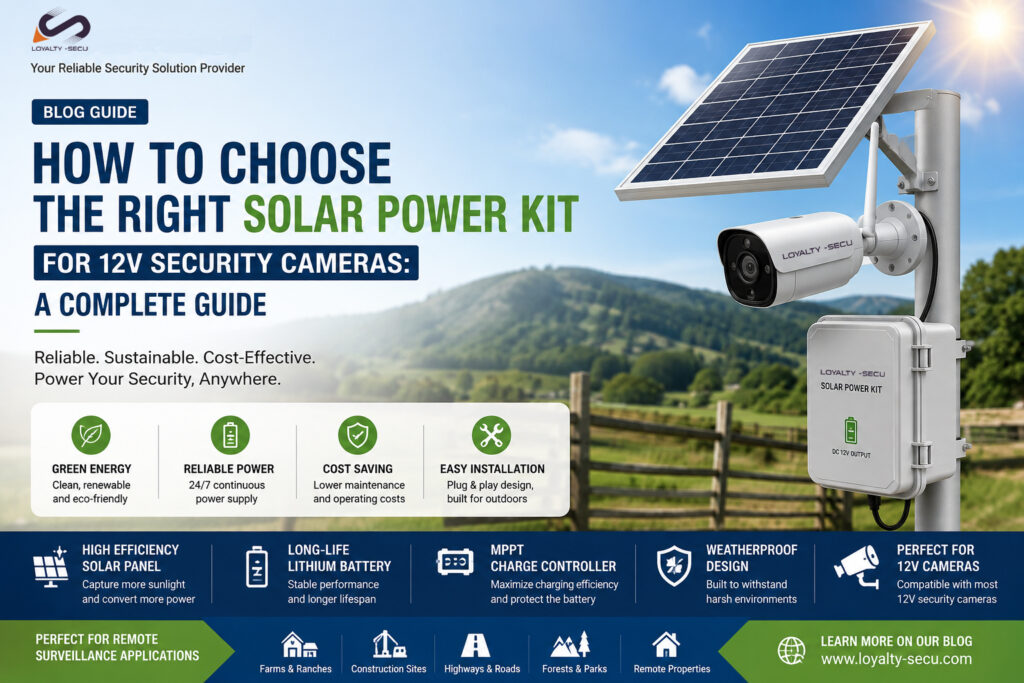
For security cameras installed in remote areas without reliable access to electricity, solar power has become an effective and sustainable solution.
Applications such as construction sites, farms, parking areas, mining locations, and temporary surveillance projects often require continuous 24/7 monitoring. However, selecting the right solar power kit is not simply about choosing a larger solar panel or battery.
The correct configuration depends on several factors, including:
- Camera power consumption
- Daily operating hours
- Weather conditions
- Battery backup requirements
- Installation environment
This guide explains how to select a suitable solar power solution for 12V security cameras.
1. Understand Your Camera Power Consumption
The first step is to calculate the power requirement of your surveillance equipment.
For example:
A customer may need to power:
- A 12V DC system consuming up to 20W
- A security camera averaging 5–8W over 24 hours
- A device consuming approximately 15–17W
Different devices require different solar power configurations.
A system that works well for a low-power fixed camera may not be sufficient for:
- PTZ cameras
- Infrared cameras
- Cameras with heaters
- Cameras with additional accessories
2. Choose the Correct Solar Panel Capacity
The solar panel provides energy to charge the battery during daylight hours.
A larger solar panel provides:
- Faster battery charging
- Better performance during cloudy days
- More power reserve
For professional surveillance applications, monocrystalline solar panels are commonly preferred because of their:
- Higher efficiency
- Better performance in limited sunlight
- Longer service life
3. Select the Right Battery Capacity
The battery determines how long the system can operate without sunlight.
When selecting battery capacity, consider:
- Nighttime operation
- Rainy days
- Seasonal sunlight differences
- Camera power consumption
Lithium batteries are widely used in modern solar surveillance systems because they provide:
- Longer cycle life
- Higher energy density
- Better charging efficiency
- Lower maintenance requirements
4. Consider Transportation and Installation Costs
For solar power kits containing lithium batteries, transportation costs can significantly affect the total project budget.
For overseas customers, sea freight is often a more economical choice compared with air shipping.
A DDP sea shipping solution can provide:
- Door-to-door delivery
- Customs clearance
- Duties and taxes included
- Lower overall logistics costs
5. Real Application Example
One U.S. customer was looking for a reliable solution to power several 12V DC surveillance devices.
Based on their initial requirements, LOYALTY-SECU recommended:
LY-SPS-8040AH
Configuration:
- 80W Solar Panel
- 40Ah Lithium Battery
After successful testing, the customer was satisfied with the performance.
Considering the customer’s future applications with higher-power cameras, we also recommended:
LY-SPS-12060AH
Configuration:
- 120W Solar Panel
- 60Ah Lithium Battery
The customer later placed a second bulk order including both models.
Read the complete project story:
→ LOYALTY-SECU Solar Power Kit Customer Case Study
Reliable Solar Power Solution for a U.S. 12V Security Camera Project | LOYALTY-SECU
Conclusion
Choosing the right solar power kit is critical for reliable off-grid surveillance.
A properly designed system should consider:
✔ Camera power consumption
✔ Solar panel capacity
✔ Battery backup time
✔ Installation environment
✔ Transportation cost
LOYALTY-SECU provides customized solar power solutions for PTZ cameras, security cameras, and remote monitoring projects.
Contact our engineering team for professional solar power recommendations.