Case Study: Solar Power Solutions for a U.S. Outdoor Security Camera Project
Project Overview
Reliable power is essential for outdoor security cameras, especially in locations where grid electricity is unavailable or difficult to access. Solar power systems provide a flexible solution for remote surveillance applications, helping reduce dependence on traditional power sources.
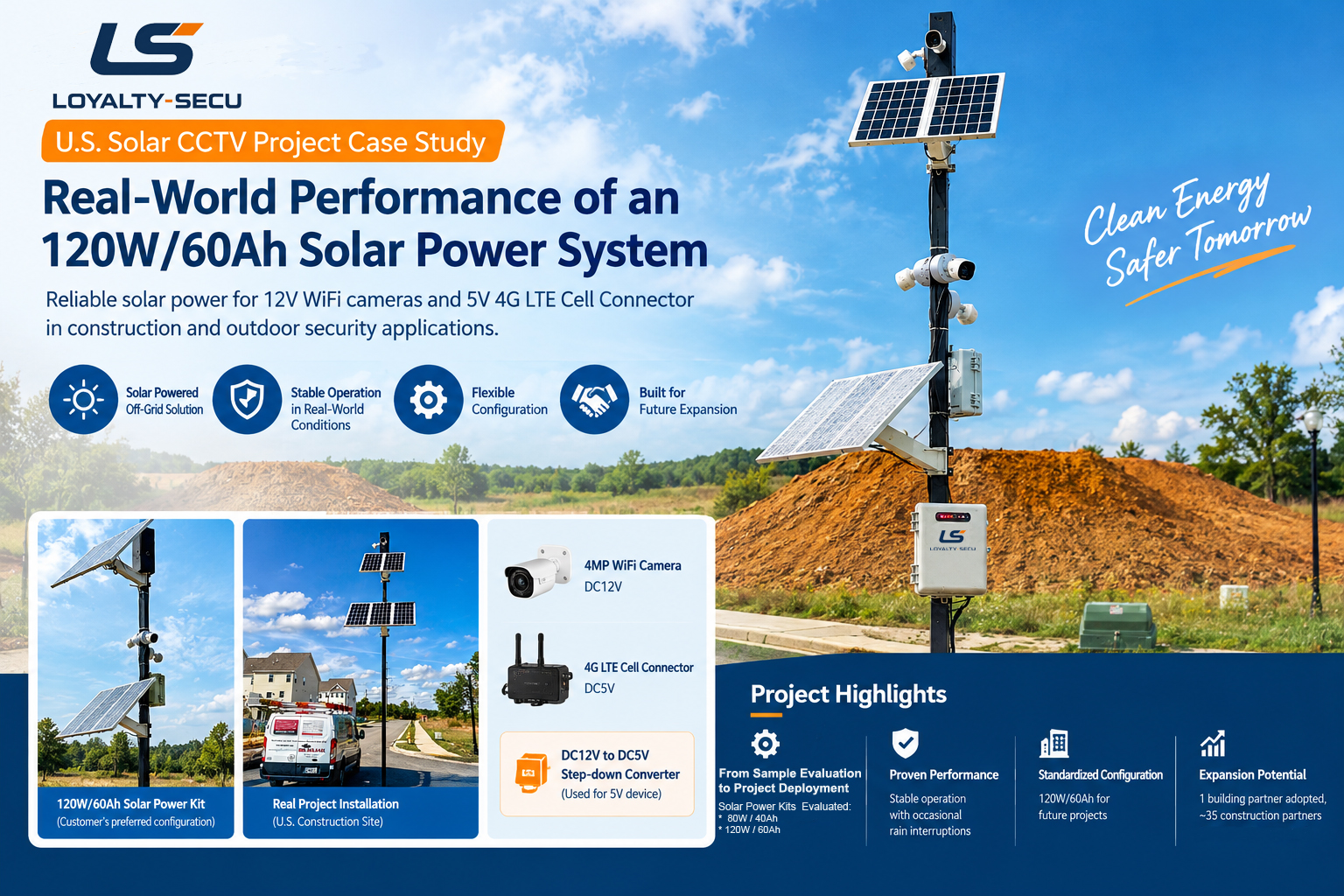
LOYALTY-SECU recently supported a U.S. customer with solar power solutions for outdoor security equipment. Following initial sample evaluation, the customer proceeded with a larger project deployment using solar kits with different power capacities.
This project highlights the importance of selecting the right solar panel and battery configuration based on the actual power consumption and operating requirements of connected devices.
Customer Requirements: Reliable Off-Grid Power for Security Cameras
The customer needed a solar power solution for outdoor surveillance equipment operating in locations without a convenient mains power supply.
The main considerations included:
- Reliable off-grid power: Supporting security equipment in outdoor environments.
- Flexible configurations: Accommodating different device combinations and power requirements.
- Battery backup: Providing stored energy for periods with limited sunlight.
- Practical installation: Integrating solar power with existing DC-powered surveillance devices.
For off-grid security applications, the solar panel, battery capacity, connected equipment, and local sunlight conditions must be considered together to achieve a suitable system configuration.
From Sample Evaluation to Project Deployment
After evaluating the initial samples, the customer moved forward with a larger order for its outdoor security applications.
The project involved solar power kits with different panel and battery capacities, providing flexibility for varying equipment requirements.
Rather than selecting a solar kit based on panel wattage alone, it is important to assess the complete power demand of the connected devices, their daily operating hours, and the required battery backup time.
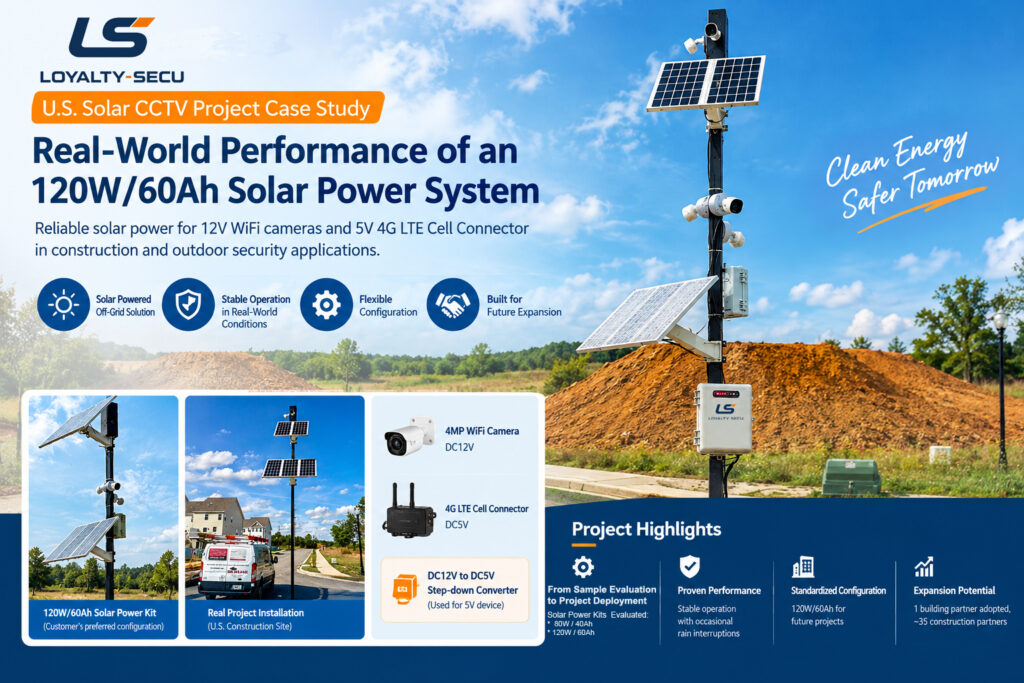
This approach helps customers identify a more suitable configuration for their specific application.
Two Typical Solar Power Applications for Outdoor Surveillance
Solar power systems can support different surveillance configurations depending on the connected devices and their total energy consumption.
Scenario 1: Powering a Security Camera and a 4G LTE Connectivity Device
A solar power kit can supply power to a 12V WiFi security camera and a compatible 5V 4G LTE connectivity device.
When the connected device requires 5V input, a suitable DC12V-to-DC5V step-down converter can be used to provide the required voltage.
When designing this type of system, it is important to account for the power consumption of both devices, converter efficiency, cable losses, and continuous operating requirements.
Scenario 2: Powering Multiple Security Cameras
A solar power kit can also be configured to supply power to multiple 12V WiFi security cameras, provided the system is appropriately sized for the combined load.
The required solar panel and battery capacities depend on factors such as:
- Total power consumption of all connected cameras
- Daily operating hours
- Local sunlight availability and seasonal variations
- Required backup time during cloudy or rainy weather
- Cable length and power conversion losses
Careful system sizing helps reduce the risk of insufficient power during periods of limited sunlight.
How to Choose the Right Solar Panel and Battery Capacity
A solar power system should be designed around the actual application rather than panel wattage alone.
1. Calculate the total power consumption
Identify the rated and actual power consumption of every connected device, including cameras, routers, and other accessories.
2. Estimate daily energy requirements
For equipment operating 24/7, calculate the expected daily energy consumption and consider additional losses from cables and voltage converters.
3. Select an appropriate battery capacity
The battery should provide sufficient energy for the required backup period. Weather conditions, battery operating limits, and usable capacity should also be considered.
4. Match the solar panel to the local environment
The panel must generate enough energy to support daily consumption and recharge the battery under the expected sunlight conditions. Locations with frequent cloudy weather may require additional capacity.
5. Consider the complete system configuration
The best solution depends on the interaction between the solar panel, battery, charge controller, output voltage, connected devices, and installation environment.
Flexible Solar Power Solutions for Outdoor Security Projects
LOYALTY-SECU provides solar power kits for DC-powered security cameras and other outdoor equipment. Different configurations can be considered according to application requirements, including panel capacity, battery capacity, output voltage, and connected-device compatibility.
For customers with specific requirements, we can discuss customized configurations to help integrate solar power with their surveillance equipment.
Whether you are deploying a standalone security camera or a multi-device outdoor surveillance system, selecting a suitable solar power solution starts with understanding the actual load and operating environment.
Looking for a solar power solution for your outdoor security project?
Contact LOYALTY-SECU to discuss your application requirements and explore a suitable configuration.