Automotive cameras play an increasingly important role in vehicle safety, driver assistance, fleet monitoring, and intelligent transportation systems. However, capturing high-quality images is only part of the process. The video signals must also be transmitted reliably to an onboard display, electronic control unit (ECU), or image processing system.
Different automotive camera transmission technologies offer different advantages in bandwidth, image quality, transmission distance, electromagnetic compatibility, wiring complexity, and system cost.
Four commonly encountered technologies are CVBS, LVDS-based interfaces, GMSL, and Automotive Ethernet. Understanding their differences helps vehicle manufacturers, system integrators, and fleet safety solution providers select the right transmission architecture for their applications.
1. CVBS: A Traditional Analog Video Interface
CVBS (Composite Video Baseband Signal) is an analog video transmission format widely used in earlier automotive camera systems.
It combines video information into a single composite signal, making the interface relatively simple and cost-effective.
Key advantages:
- Low hardware cost and relatively simple implementation.
- Straightforward integration with compatible analog video systems.
- Suitable for basic rear-view monitoring and other applications with modest image-quality requirements.
Limitations:
- Limited image detail compared with modern digital video interfaces.
- Susceptibility to noise, interference, and image degradation depending on cable quality and the electromagnetic environment.
- Limited suitability for high-resolution imaging and advanced computer vision applications.
Typical applications: Basic reversing cameras and legacy vehicle video systems.
Although CVBS remains useful in some cost-sensitive applications, it is less suitable for new systems requiring high-resolution images or advanced image analysis.
2. LVDS: High-Speed Differential Signal Transmission
LVDS (Low-Voltage Differential Signaling) is a differential electrical signaling technology designed for high-speed data transmission with relatively low power consumption and good noise immunity.
In automotive camera systems, LVDS-based interfaces can support digital video transmission with low latency. However, the achievable resolution, data rate, and transmission distance depend on the specific interface implementation, serializer/deserializer architecture, and cable design.
Key advantages:
- Better resistance to common-mode noise than many single-ended signaling approaches.
- Low-latency transmission suitable for real-time video applications.
- Relatively low power consumption.
- Suitable for digital video links between cameras, displays, and processing units.
Limitations:
- Performance depends on the specific interface and implementation.
- Dedicated point-to-point links may require additional cabling as the number of cameras increases.
- Multi-camera integration can become more complex without an appropriate aggregation architecture.
Typical applications: Automotive displays, digital camera links, and systems using LVDS-based video interfaces.
It is important to distinguish basic LVDS signaling from automotive camera link technologies that use differential signaling as part of a more integrated transmission system.
3. GMSL: High-Speed Automotive Camera Connectivity
GMSL (Gigabit Multimedia Serial Link) is a high-speed serial link technology developed for applications such as automotive cameras, displays, and advanced driver assistance systems (ADAS).
GMSL systems typically use serializer and deserializer devices to transmit high-speed video over suitable automotive cables. Depending on the implementation, the link can also support control-channel communication and power delivery over the same cable.
Key advantages:
- Supports high-bandwidth digital video transmission, including high-resolution camera applications.
- Enables relatively long camera-to-ECU connections when the appropriate cable and link configuration are used.
- Can reduce wiring complexity compared with architectures requiring separate cables for video, control, and power.
- Supports bidirectional communication in compatible configurations, allowing the host system to configure or control connected cameras.
- Suitable for multi-camera architectures used in ADAS and vehicle monitoring systems.
Limitations:
- Requires compatible serializer/deserializer hardware at the transmitting and receiving ends.
- Cable selection, connector quality, electromagnetic compatibility, and link configuration must be carefully considered.
- Component costs and integration complexity may be higher than those of basic analog video solutions.
Typical applications: ADAS cameras, surround-view systems, high-resolution vehicle cameras, and commercial vehicle vision systems.
GMSL is particularly relevant when a vehicle requires reliable high-speed video transmission over dedicated camera links without introducing unnecessary wiring complexity.
4. Automotive Ethernet: A Network-Based Approach
Automotive Ethernet is an Ethernet-based communication technology designed for vehicle electronic systems. Depending on the physical layer and network architecture, it can support high-bandwidth communication between cameras, ECUs, domain controllers, and other onboard devices.
Unlike a conventional dedicated video link, Automotive Ethernet can integrate camera data into a broader vehicle communication network.
Key advantages:
- Supports high-bandwidth data transmission, depending on the selected Ethernet standard.
- Enables network-based communication among multiple electronic devices.
- Can facilitate integration with centralized computing platforms and multi-sensor processing systems.
- Benefits from established Ethernet networking concepts and standardized protocols.
Limitations:
- Requires compatible network interfaces, physical-layer components, and appropriate system architecture.
- Bandwidth, latency, synchronization, and network traffic must be managed according to application requirements.
- Hardware, software, and integration costs depend on the selected implementation.
- Automotive-grade cabling, connectors, and electromagnetic compatibility design remain important.
Typical applications: Centralized vehicle computing, multi-camera networks, advanced driver assistance systems, and next-generation vehicle electronic architectures.
Automotive Ethernet is a strong option for network-oriented vehicle architectures, especially when camera data needs to be integrated with other vehicle information. However, it is not automatically the best choice for every camera connection; the required bandwidth, latency, and system architecture must determine the selection.
5.Comparison of Automotive Camera Transmission Technologies
| Feature | CVBS | LVDS-Based Links | GMSL | Automotive Ethernet |
| Signal type | Analog video | Differential digital signaling | High-speed serial link | Network-based digital communication |
| Image capability | Generally low resolution | Depends on implementation | Supports high-resolution video | Depends on bandwidth and system design |
| Transmission distance | Depends on cable and signal quality | Depends on interface and cable | Suitable for dedicated camera links over automotive cable | Depends on Ethernet standard and physical layer |
| Noise immunity | More susceptible to signal degradation | Good with proper differential design | Designed for demanding automotive environments | Depends on physical layer, cabling, and system design |
| Wiring architecture | Relatively simple | Often dedicated links | Dedicated high-speed links with possible control and power integration | Network-based architecture |
| System complexity | Low | Low to moderate for simple links | Moderate | Moderate to high |
| Typical use cases | Basic reversing cameras | Digital video and display links | ADAS and high-resolution vehicle cameras | Networked cameras and centralized vehicle systems |
Note: Actual performance varies by implementation. LVDS is a signaling technology rather than a single fixed-resolution camera standard. GMSL capabilities and Automotive Ethernet performance depend on the selected generation, hardware, cable, and system architecture.
6. How to Choose the Right Transmission Technology
The best transmission technology depends on the vehicle application rather than on a single specification.
For basic reversing cameras
CVBS may remain a practical option when cost is the main priority and high-resolution image processing is not required.
For conventional digital video connections
LVDS-based interfaces can be suitable for applications requiring low-latency digital transmission, provided that the selected interface meets the required bandwidth and cable-length requirements.
For high-resolution cameras and ADAS
GMSL is worth considering when the system requires high-bandwidth video, dedicated camera links, and efficient integration of control signals.
For multi-camera networks and centralized computing
Automotive Ethernet may be appropriate when the vehicle architecture is designed around networked communication and integration with multiple electronic systems.
Before selecting an interface, engineers should evaluate the following factors:
- Image resolution and frame rate: Determine the required video data rate and image-processing needs.
- Transmission distance: Consider the physical distance between each camera and the host processing unit.
- Electromagnetic compatibility: Evaluate interference from motors, power electronics, and other onboard systems.
- Number of cameras: Assess cable routing, connection topology, and the need for aggregation.
- Power and control requirements: Determine whether video, camera control, and power can be integrated into the same cable.
- Total system cost: Consider not only the camera interface but also cabling, connectors, processing hardware, and integration effort.
- Future scalability: Consider whether the architecture can accommodate additional cameras or higher data rates.
Conclusion
CVBS, LVDS-based interfaces, GMSL, and Automotive Ethernet serve different purposes in automotive vision systems.
CVBS remains relevant for basic, cost-sensitive video applications. LVDS-based interfaces provide differential digital signaling for suitable video links. GMSL is designed for high-speed automotive camera connectivity, while Automotive Ethernet supports network-based vehicle architectures and integration with centralized computing systems.
The right choice is the one that balances image quality, transmission reliability, cable requirements, system complexity, and overall cost for the intended vehicle application.
For automotive camera manufacturers and system integrators, evaluating the complete transmission architecture early in the design process can help reduce integration risks and build a more reliable vehicle vision solution.
Explore LOYALTY-SECU Smart Vehicle Safety Solutions
Choosing the right camera transmission technology is only one part of building a reliable vehicle safety system. Camera placement, blind-spot coverage, driver monitoring, video recording, and remote fleet management also play important roles in overall system performance.
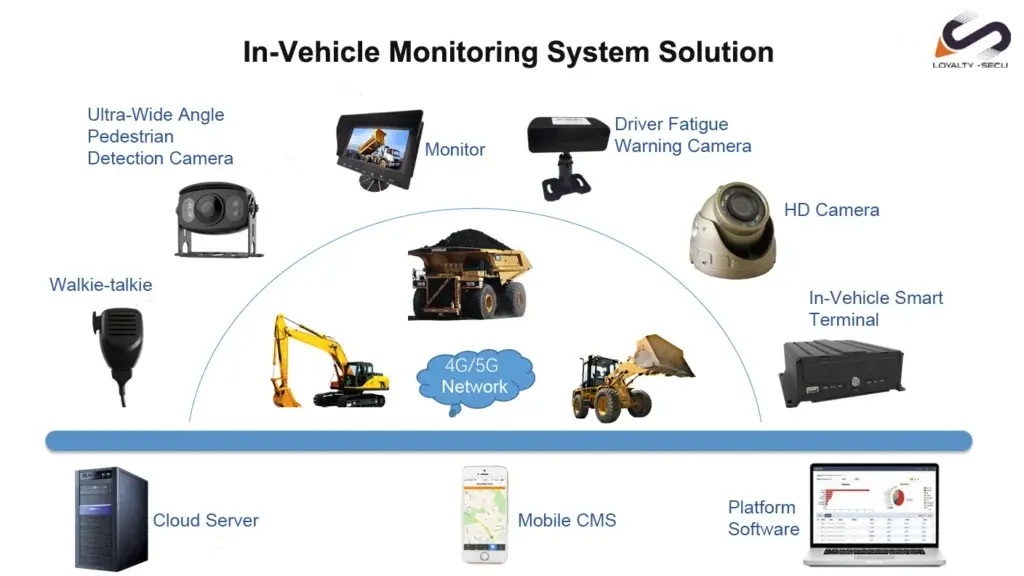
LOYALTY-SECU provides smart vehicle safety solutions for commercial fleets, construction machinery, and special-purpose vehicles. Our solutions cover functions such as 4G remote video monitoring, GPS tracking, driver behavior monitoring, and blind-spot warning, helping customers evaluate suitable safety configurations for their vehicle applications.
Looking for a vehicle safety solution for your project?
Explore our LOYALTY-SECU Smart Vehicle Safety Solutions to learn more about our systems and customization opportunities.