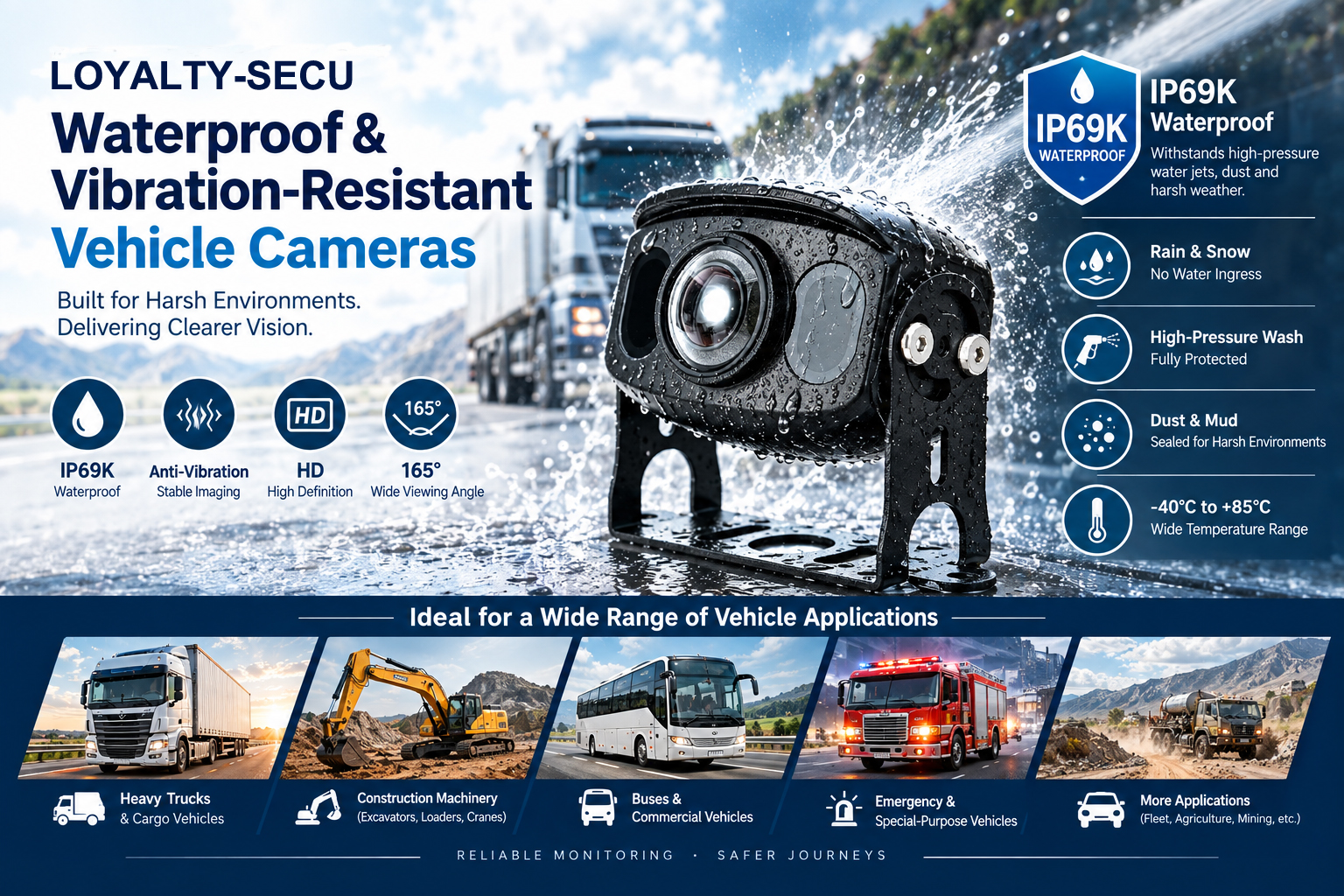
Vehicle cameras play an important role in modern vehicle surveillance and mobile video monitoring systems. Unlike conventional security cameras designed for indoor or fixed installations, vehicle cameras must operate reliably while exposed to continuous vibration, rain, dust, water spray, temperature changes, and frequent vehicle washing.
For heavy trucks, cargo vehicles, construction machinery, buses, emergency vehicles, and other commercial vehicles, waterproof and vibration-resistant performance is essential for maintaining reliable video monitoring in demanding environments.
Among the many specifications to consider when selecting a vehicle camera, environmental protection and mechanical stability are two key factors that directly affect long-term performance.
Why Waterproof and Vibration Resistance Matter for Vehicle Cameras
Vehicles operate in constantly changing environments. A camera installed on a truck or construction machine may experience road vibration, mechanical shock, rain, mud, dust, water spray, and high-pressure cleaning during everyday operation.
If a camera is not adequately protected, moisture may enter the housing, while continuous vibration may affect the lens, mounting structure, or image stability.
Common problems can include:
- Water or moisture entering the camera housing
- Lens fogging or reduced image clarity
- Unstable video caused by vibration
- Changes in the camera viewing angle
- Electronic component damage
- Reduced equipment service life
A professionally designed waterproof and vibration-resistant vehicle camera helps reduce these risks and provides more reliable video monitoring in mobile applications.
How IP69K Waterproof Protection Works
Waterproof protection in vehicle cameras is achieved through a combination of sealed mechanical construction, waterproof materials, and manufacturing processes.
A rugged vehicle camera may use integrated housing with sealing components around critical connection points. Waterproof gaskets, protected cable connections, sealed lens structures, and other design elements help prevent water and moisture from entering sensitive internal components.
What Does IP69K Mean?
For heavy-duty applications, IP69K represents a high level of enclosure protection against dust and powerful high-temperature water jets under specified testing conditions.
This makes IP69K waterproof vehicle cameras particularly suitable for environments where cameras may be exposed to:
- Heavy rain and water spray
- Dust and mud
- High-pressure cleaning
- Frequent vehicle washing
- Harsh outdoor environments
Compared with cameras designed only for ordinary indoor or light outdoor use, an IP69K-rated camera is better suited to demanding mobile applications where environmental protection is important.
However, the IP rating applies to the tested enclosure under specified conditions. Actual system protection can also depend on installation, cable connections, mounting, and other components. Users should always check the manufacturer’s specifications when selecting a waterproof vehicle camera.
How Vibration Resistance Improves Vehicle Camera Performance
Waterproof protection is only one part of vehicle camera reliability. Vibration resistance is equally important for cameras installed on moving vehicles.
Heavy trucks, construction machinery, and other commercial vehicles frequently travel over uneven roads, gravel surfaces, speed bumps, or rough working areas. Continuous vibration can be transmitted from the vehicle body to the camera and lens.
Excessive vibration may result in:
- Shaking video
- Motion blur
- Unstable viewing angles
- Reduced image clarity
- Mechanical stress on internal components
Mechanical Vibration Reduction
Mechanical vibration reduction focuses on minimizing vibration transferred from the vehicle to the camera.
Depending on the camera design, this may include:
- Shock-absorbing mounting structures
- Rubber or silicone damping materials
- Reinforced camera housing
- Stable lens mounting structures
- Heavy-duty mounting brackets
A stable mounting system is especially important for vehicle surveillance cameras installed on heavy trucks and construction equipment.
Electronic Image Stabilization
Some vehicle camera systems also use electronic image stabilization to compensate for small image movements.
The camera processor analyzes changes between consecutive frames and can compensate for part of the detected image displacement. This can help produce smoother video when the camera is affected by small movements.
The actual stabilization technology varies by camera model. Therefore, users should check the manufacturer’s specifications to determine whether a particular vehicle camera supports electronic image stabilization.
Key Benefits of Waterproof and Vibration-Resistant Vehicle Cameras
1. Reliable Operation in Harsh Outdoor Environments
An IP69K waterproof vehicle camera can provide a high level of protection against dust, water spray, and high-pressure cleaning under specified conditions.
This is particularly valuable for vehicles that operate outdoors for long periods or are frequently exposed to water and dirt.
2. More Stable Video on Rough Roads
Vibration-resistant construction and stable mounting help maintain a more consistent camera view while vehicles are moving.
This can improve visibility of:
- Road conditions
- Surrounding vehicles
- Pedestrians
- Blind spots
- Cargo areas
- Construction areas
3. More Reliable Video Evidence
Vehicle surveillance footage can be important for incident investigation and operational monitoring.
Reliable video can help document:
- Traffic incidents
- Vehicle movements
- Road conditions
- Loading and unloading activities
- Cargo areas
- Surrounding vehicles and pedestrians
For fleet operators and commercial transportation companies, dependable video footage can provide useful visual evidence when investigating accidents or operational events.
4. Improved Long-Term Reliability
Water, dust, vibration, and mechanical impact are common challenges for mobile surveillance equipment.
Combining IP69K waterproof protection, rugged construction, and stable mounting can help reduce environmental damage and support more reliable long-term operation.
Applications of IP69K Vehicle Cameras
Heavy Trucks and Cargo Vehicles
Heavy trucks and cargo vehicles often operate in outdoor environments where rain, dust, mud, and road vibration are unavoidable.
A wide-angle vehicle camera can provide broader visual coverage around the vehicle, helping monitor blind spots, road conditions, cargo areas, and surrounding traffic.
Construction Machinery
Excavators, loaders, cranes, and other construction machinery operate in demanding environments with significant vibration, dust, mud, and water exposure.
An IP69K vehicle camera for construction machinery can provide additional visibility while offering strong environmental protection for outdoor operation.
Buses and Commercial Vehicles
Vehicle cameras can be installed inside or outside buses and commercial vehicles for passenger monitoring, road observation, blind-spot monitoring, and incident recording.
For exterior installations, waterproof protection becomes particularly important.
Emergency and Special-Purpose Vehicles
Fire trucks, rescue vehicles, police vehicles, and other special-purpose vehicles may require reliable video monitoring under challenging conditions.
A rugged waterproof vehicle camera can help maintain monitoring performance when vehicles are exposed to rain, water spray, vibration, and frequent cleaning.
How to Choose the Right Vehicle Camera
When selecting a vehicle camera, waterproofing and vibration resistance should be considered together with other specifications.
IP Protection Rating
Check the manufacturer’s actual IP rating and testing specifications.
For demanding outdoor applications, IP69K waterproof protection can be an important consideration where high-pressure cleaning or significant water exposure is expected.
Viewing Angle
The viewing angle determines how much of the surrounding area the camera can capture.
A 165° wide-angle vehicle camera can provide broad coverage and help reduce blind spots around large vehicles.
Image Resolution
Higher resolution can provide more useful detail for monitoring, identification, and incident investigation.
Night Vision
For 24/7 vehicle surveillance, infrared or other low-light imaging technologies may be required depending on the application.
Mounting Structure
A stable mounting solution is essential for maintaining the desired viewing angle and reducing the effects of continuous vehicle vibration.
Connectivity and Recording
Depending on the project, the camera may work with local storage, an onboard monitor, or a 4G/5G remote video monitoring platform.
LOYALTY-SECU IP69K Waterproof Vehicle Camera
LOYALTY-SECU provides vehicle camera solutions for heavy trucks, cargo vehicles, construction machinery, and other mobile video surveillance applications.
The 165° Wide-Viewing-Angle In-Vehicle Mobile Video Camera Surveillance System is designed for heavy vehicles and cargo trucks where broad visual coverage is important.
Its 165° wide viewing angle provides a broad field of view around the vehicle, helping improve visibility in applications where vehicle surroundings and blind-spot monitoring are important.
With IP69K waterproof protection, the camera is designed for demanding outdoor environments where protection against water, dust, and high-pressure cleaning is required.
This combination of wide-angle coverage and rugged environmental protection makes the camera suitable for various heavy vehicle and commercial transportation applications.
View the LOYALTY-SECU 165° Wide-Viewing-Angle Vehicle Camera
Conclusion
For modern mobile video surveillance, IP69K waterproof and vibration-resistant performance is an important consideration when selecting a vehicle camera.
A professionally designed vehicle camera combines environmental protection, rugged construction, stable mounting, and reliable imaging technology to provide dependable video monitoring in demanding mobile environments.
For heavy trucks, construction machinery, buses, emergency vehicles, and other commercial vehicles, choosing the right waterproof vehicle camera can improve surveillance reliability, video quality, and long-term equipment performance.
By evaluating factors such as IP protection, vibration resistance, viewing angle, image resolution, night vision, mounting structure, connectivity, and recording, users can select a vehicle camera that better matches their specific operating environment and surveillance requirements.